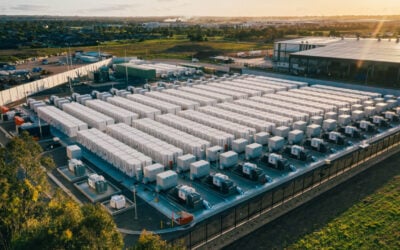
More than AU$1 billion (US$0.65 billion) of financial commitments to large-scale battery energy storage system (BESS) projects were made in Australia in the second quarter of this year.
If hybrid (generation-plus-storage) projects were to also be counted, the investment commitments exceed AU$2 billion.
It marks the first time that the “billion-dollar barrier” has been breached during a single quarter, according to the national Clean Energy Council (CEC) trade group, which has just published its latest Renewable Projects Quarterly Report into activity in the space.
CEC said six BESS projects totalling 1,497MW of output and 3,802MWh of storage capacity were committed to in the three-month period ending 30 June 2023.
Try Premium for just $1
- Full premium access for the first month at only $1
- Converts to an annual rate after 30 days unless cancelled
- Cancel anytime during the trial period
Premium Benefits
- Expert industry analysis and interviews
- Digital access to PV Tech Power journal
- Exclusive event discounts
Or get the full Premium subscription right away
Or continue reading this article for free
Meanwhile, four large-scale BESS projects were brought into commercial operation for a combined 460MWh of capacity, representing AU$350 million invested, and two projects are under construction, adding up to 2,480MWh and AU$1.1 billion investment.
Q1 was much quieter for financial commitments into new projects, with just one project of 200MWh. Similarly, there was just one 800MWh large-scale BESS under construction during Q1.
State-by-state, New South Wales (NSW) led the way, with a total of 13 projects financially committed to or under construction as of the end of Q2, representing 3,126MW/8166MWh of storage and AU$2.36 billion investment.
In joint second place for number of projects committed to or in construction with seven each were South Australia and Western Australia. However South Australia had almost double the output and capacity of BESS projects Western Australia did, with 1187MW/2864MWh versus 606MW/1754MWh, although Western Australia projects represented bigger investments in financial terms.
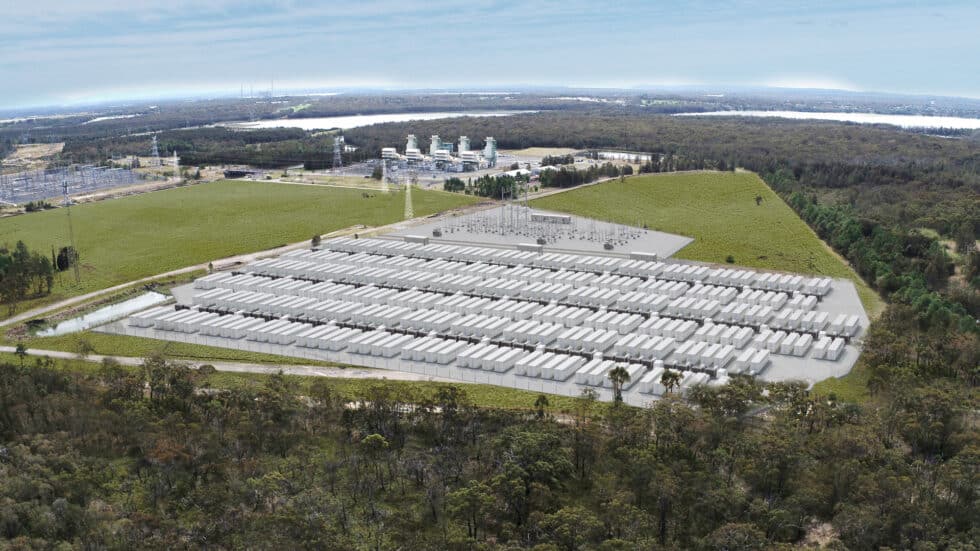
A large portion of the Q2 numbers, or perhaps Q2 success, can be attributed to the Waratah Super Battery now under construction in Western Australia, designed as a “giant shock absorber” for the electricity system according to the state’s government, which is financially supporting the project.
Waratah Super Battery, which Energy-Storage.news has extensively covered through its development journey, will be at least 850MW/1,680MWh.
Bright spot in Australia amid renewable energy market challenges
However, the growth in battery storage activity was the standout clean energy technology in what has been otherwise a challenging couple of quarters for the sector, according to the report.
Just four solar PV or wind large-scale generation projects totalling 384MW and around AU$225 million were committed to in Q2.
This was less than the rolling quarterly average over the past 12 months by more than a billion Australian dollars, and yet the smashing of records for standalone and hybrid energy storage investments drove the overall sums committed back to above the average.
Notably, the single largest among generation projects under construction is Ardandra Storage and Solar in Queensland, which is a hybrid combining 175MW of solar PV with 400MWh battery storage.
CEC chief executive Kane Thornton said barriers to large-scale renewables remain due to “the historic lack of leadership, planning and foresight over the prior decade”. The present federal Labor Party government headed up by prime minister Anthony Albanese was elected partly on a platform of action on climate change and long-term energy security after prior Liberal Party administrations had become known for inaction on climate and support for propping up the fossil fuel industries.
“These challenges make final investment decisions for large scale renewables projects more difficult, and include under-investment in transmission, grid connection challenges, inconsistent planning policies, constraints in supply chains and workforce as Australia competes with global leaders that are all accelerating their demand for renewable energy,” Kane Thornton said.
Although there is a pipeline of opportunity that continues to grow, Thornton added that right now, international investors are looking elsewhere as global opportunities are made to look even more attractive given the barriers present in Australia.
Additionally, although the battery sector is enjoying a boom, it still appears to be requiring a level of support. All three standalone energy storage system projects committed to in the quarter received funding or concessional financing from a government body, CEC said.